
Checking for a Warrant in Haywood County
Match the paper to the office. The Circuit Court Clerk keeps county criminal warrants plus traffic tickets written by a Tennessee State Trooper or county deputy. The Sheriff tracks service separately, and neither office posts a countywide warrant roster for Haywood County. Before you call, gather the case or citation number, court, date, and issuing agency. Offer a birth date only when the clerk needs it to separate similar names. Ask the issuing court about status and the Sheriff about service.
- Read the notice and identify its court, agency, case number, and date.
- Call the Circuit or General Sessions Clerk for a county criminal or traffic file.
- Ask Brownsville City Court or Stanton Town Hall about a town ordinance matter.
- Call the Sheriff's Office for service information, or request a specific existing record under its public-record policy.
- Ask an attorney and the issuing court about appearance, bond, reset, or recall steps before acting.
Start a Haywood County warrant check with the Circuit and General Sessions Clerk page, which lists the office and its contact routes. Circuit Court also has a lobby terminal, though its search fields and warrant coverage are not documented.
That clerk page is a contact block for the office, not a warrant result. Call the Haywood County clerk and ask which records it can confirm for you.
Haywood County Clerk and Sheriff Warrant Records
The clerk keeps the court file, while the Sheriff may hold a separate service record. One office's answer may not cover the other system, and neither replaces the issuing judge's order. If a search comes back empty, ask which file and system were checked. The Sheriff's published main line is not a dedicated warrant desk, and it does not run 24-hour confirmations. Sharing a street address does not merge the offices' records into one search. The official court-system map sorts Circuit, General Sessions, Juvenile, and Chancery within Tennessee's 28th Judicial District. Brownsville and Stanton run their own municipal courts, and the Chancery Court page spells out a separate Clerk and Master route for Haywood County.
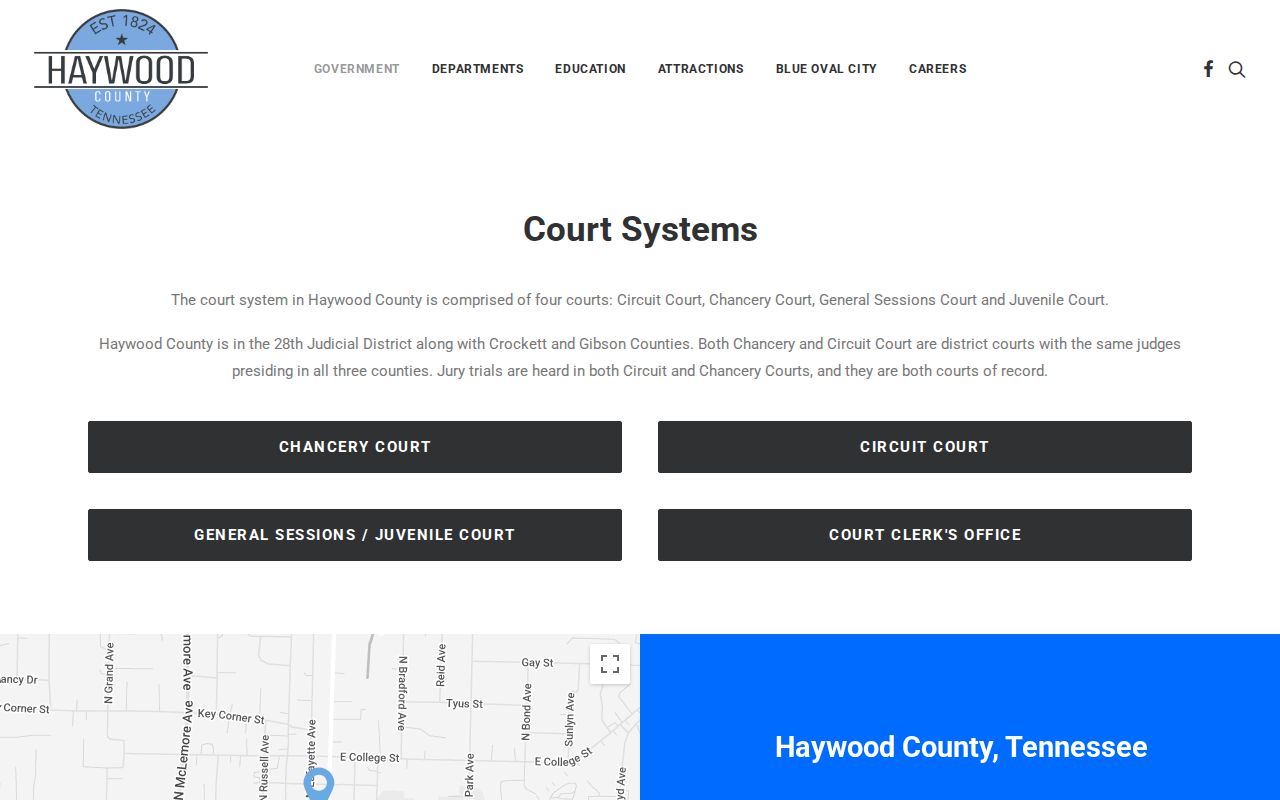
The court-system page routes each request by court, so a Haywood County search does not mix municipal and county dockets. The Chancery Court office entry lists the address and record-access details for that route.

The Chancery image identifies a family and probate route, not a criminal-warrant archive.
Haywood County Warrant Types
Different terms point to different files. In Haywood County, an arrest warrant follows a sworn complaint and a probable-cause decision, while a bench warrant usually follows a missed appearance or an unmet court condition. A Rule 9 capias comes after an indictment or presentment. A city ordinance matter may belong to Brownsville or Stanton instead.
| Process | How It Can Arise | First Record Route |
|---|---|---|
| Arrest warrant | Sworn complaint and court authorization | General Sessions or issuing court clerk |
| Bench warrant / FTA | Missed citation, summons, or court date | Court that set the appearance |
| Rule 9 capias | Indictment or presentment | Circuit Clerk |
| Municipal warrant | City or town ordinance docket | Brownsville City Court or Stanton Town Hall |
| Search warrant | Authorization to search specified places or things | Issuing court, subject to access limits |
Haywood County pages also use labels like re-arrest warrant and detainer warrant. Ask the court which process it means before treating the terms as the same thing.
Haywood County Municipal Warrant Routes: Brownsville and Stanton
Haywood's two incorporated cities run separate routes. Brownsville, the county seat, has a charter-created City Court, and Stanton's code gives its City Judge authority over ordinance process. Those files can sit outside the county docket. The court named on the paper matters more than where a traffic stop happened, since the county clerk handles Tennessee State Trooper and Sheriff's Department tickets as General Sessions work. Brownsville or Stanton ordinance citations may go to municipal court instead. Use the contact printed on the ticket.
Inside a Haywood County Warrant Record
Haywood County has published no blank arrest or bench-warrant sample. These Tennessee procedure and local court clues can help you identify the right file. They are not a promise that every item appears on each record.
| Warrant or process number | A unique reference may be assigned, but Haywood does not publish a number format. |
|---|---|
| Case and court | Shows which Circuit, General Sessions, or municipal file controls the next step. |
| Process type | May say arrest warrant, bench warrant, summons, capias, or another court term. |
| Issue and return | Can identify when the order was authorized and whether service was returned. |
| Bond and status | Ask the clerk to confirm current court status and any appearance terms; no county bond schedule is published. |
GS-EXAMPLE-0000 is a made-up illustration, not a real Haywood County case number; ask the clerk for the court's current status and note the date you confirmed it.
What the Public Terminal Does Not Say
The Circuit Court page notes a public lobby terminal for Haywood County records but says nothing about its software, search fields, status labels, or warrant coverage. So call first. Ask when the terminal is open and which records it actually covers. Remember that a docket line, a scanned order, a payment page, and a Sheriff service record each answer a different question, and a blank search result does not prove that no warrant exists.
Issuing and Serving Warrants in Haywood County
A judge, magistrate, or other authorized official issues the warrant in Haywood County. The clerk keeps the court file. A deputy, a city officer, or a Tennessee Highway Patrol officer may serve or return it, and the clerk may not see every agency's update.
Haywood County Sheriff's Office
100 South Dupree
Brownsville, TN 38012
731-772-6158
The Sheriff's page posts public contact details and a records policy, but Haywood County lists no separate warrant unit, roster, or surrender counter. Ask which office can confirm service and the current court status.
Haywood County Warrants and the Statewide Gap
No public, name-searchable statewide warrant repository was identified in reviewed official sources. TIES, THOR, and NCIC-linked systems serve justice agencies. TBI Most Wanted is curated, not a complete Haywood list. A state license action after FTA or nonpayment is not a warrant search.
Check the issuing court and then the serving agency. A clerk may limit protected details, and an office that does not hold the file cannot establish that process is cleared.
If You Have a Warrant in Haywood County
If the clerk confirms a warrant, ask which Haywood County court issued it and what options apply. An appearance, bond, payment, new date, or motion can each have different effects. Haywood publishes no universal surrender procedure or bond schedule. So ask before you go. Where should you report, should a lawyer arrange it, which papers do you need, and what paperwork proves recall or release? A receipt alone may not prove the warrant was recalled.
Important: Confirm the next step with the issuing clerk or a Tennessee attorney; no walk-in surrender hours are published.
Haywood County Warrant Records After Resolution
Hold on to whatever paper proves the outcome in Haywood County: the order, the receipt, the compliance form, or the docket entry. Payment, license reinstatement, and warrant recall are separate steps. Ask whether a state license action needs its own release paperwork. The clerk, the Sheriff, and the state systems publish no update schedule, so ask when each file refreshes. Then write down the date, process number, and status you were given.
Haywood County Warrant Records and Public Access
Tennessee's Public Records Act lets citizens inspect records that already exist at the right office, subject to exemptions. Court files also follow court rules. A request can pull an existing docket entry or process document. It cannot make an agency build a countywide roster, run a fresh legal search, or interpret a warrant. In Haywood County, ask the office that holds the record.
Key Rules:
Tennessee Public Records Act, Tenn. Code Ann. §§ 10-7-501 et seq. covers access to existing public records, with limits and request procedures.
Tennessee Supreme Court Rule 34 sets court-record access rules, including sealed and confidential records.
Tennessee Juvenile Rule 114 protects juvenile proceeding records from ordinary public access.
Haywood County Warrant Records Request Route
The Haywood County Sheriff accepts inspection requests orally or in writing, but copy requests must be written and specific. If prompt production is impractical, a response is due within seven business days, and that response need not include the records. Rates are listed as $0.15 for black-and-white copies and $0.50 for color. The policy text conflicts, though, and sets no labor threshold. Ask the PRRC to confirm what currently applies. Describe the record and date range, then ask for an estimate. A case number, court, and date narrow things fast; the office still need not create a new roster.
Haywood County Warrants by City
Brownsville and Stanton each run a municipal court with public-record routes. Neither city posts a warrant search. The court named on the paper decides whether you call a town or the Haywood County clerk.
Brownsville Warrant Search
2026 certified estimate: 9,788. City Police and charter-created City Court keep separate city routes.
Stanton Warrant Search
2025 certified population: 417. Town Hall, City Court, and a newly formed Police Department provide the local route.
The population figures use different source years. Unincorporated communities are not separate city-court jurisdictions.
Western District Federal Warrants for Haywood County
A Western District of Tennessee matter runs through the federal court and its service agencies. Jackson is the division route for Haywood. The U.S. Marshals Service describes a Two Rivers fugitive task force. Living in Haywood County does not change the court named on the paper. PACER covers federal dockets, not Haywood warrants, and the county clerk cannot recall federal process, so use the federal court or counsel.